
Alexandria National Cemetery History
On Veterans Day, I spent part of the morning walking through Alexandria National Cemetery. It’s a peaceful place at the west end of Wilkes Street in Old Town Alexandria. Many people who visit Northern Virginia know about Arlington National Cemetery. Fewer know that Alexandria’s national cemetery opened two years earlier, in 1862. Today, there are 4,066 marked graves and 123 unknown graves that span five and a half acres. To understand why the cemetery is here, it helps to go back to the first weeks of the Civil War.
Alexandria under Union occupation

On May 23, 1861, Virginia voters ratified the state’s ordinance of secession. The next morning, Union troops crossed the Potomac River and took control of Alexandria and Arlington. As federal troops entered Alexandria, local militia units left the city. Some of those men went by train to Manassas Junction and later became part of the 17th Virginia Infantry. Alexandria remained under Union occupation for the rest of the war.
Alexandria’s port and railroads made the city an important supply center for the Union Army. Those same railroads brought sick and wounded soldiers back from the front. By the end of the war, Alexandria had more than 30 military hospitals with room for about 6,500 patients. The Army used churches, private homes, and hotels as hospitals. One of the largest was Mansion House Hospital, which included the hotel in front of Carlyle House and had about 500 beds. If you’ve visited Carlyle House on North Fairfax Street, you’ve been to part of that hospital site.
From Soldiers’ Cemetery to Arlington

Some of the men who died in Alexandria had been wounded in battle. Others died of disease. The Army needed a place to bury them, so in 1862 the federal government set aside land near the existing burial grounds off Wilkes Street. It became known as Soldiers’ Cemetery. It was one of 14 national cemeteries established in 1862. By 1864, the cemetery was nearly full.
The shortage of burial space in Alexandria and elsewhere around Washington helped lead to the establishment of Arlington National Cemetery. There’s a George Washington connection to that story. Arlington House was built by George Washington Parke Custis, Martha Washington’s grandson and George Washington’s step-grandson. His daughter Mary married Robert E. Lee, who became the executor of Custis’s will after Custis died in 1857. The Union Army occupied the estate in 1861. Military burials began there in May 1864, and the government formally designated Arlington a national cemetery on June 15.
The United States Colored Troops
One of the most important stories at Alexandria National Cemetery is also part of the city’s civil rights history. During the Civil War, some black Union soldiers who died in Alexandria were buried at what is now known as Contrabands and Freedmen Cemetery. The cemetery served the city’s black civilian population, including many people who had escaped slavery and sought refuge behind Union lines. The Army referred to these freedom seekers as “contrabands.”
The term goes back to a decision made early in the war. In May 1861, three enslaved men escaped to Fort Monroe, Virginia, where Union General Benjamin Butler was in command. When a Confederate officer demanded their return, Butler pointed out that Virginia claimed to have left the United States and argued that he had no obligation to enforce the Fugitive Slave Act on its behalf. The men had been put to work on Confederate fortifications. Butler turned the Confederacy’s own claim that they were property against it, treating them as “contraband of war” and refusing to send them back. His decision opened a path for others to seek refuge behind Union lines.
Union-occupied Alexandria became one of the places people came to seek freedom. By 1865, estimates of the number of freedom seekers in the city reached 8,000 to 10,000. Some men who escaped slavery went on to serve in the Union Army as members of the United States Colored Troops (USCT). In Alexandria, the question of where black soldiers would be buried brought the distinction between civilian refugees and men in uniform into focus.
In December 1864, 443 black Union soldiers signed a petition asking for the same right to burial in Soldiers’ Cemetery as their white fellow soldiers. Many were recovering at L’Ouverture Hospital. They wrote, “We are not contrabands, but soldiers of the U.S. Army.” Quartermaster General Montgomery C. Meigs granted their request. In January 1865, the Army moved the remains of 118 soldiers from Freedmen’s Cemetery to what is now Section B of Alexandria National Cemetery. Twenty-three of the men who signed the petition are also buried at Alexandria National Cemetery.
Visiting Alexandria National Cemetery
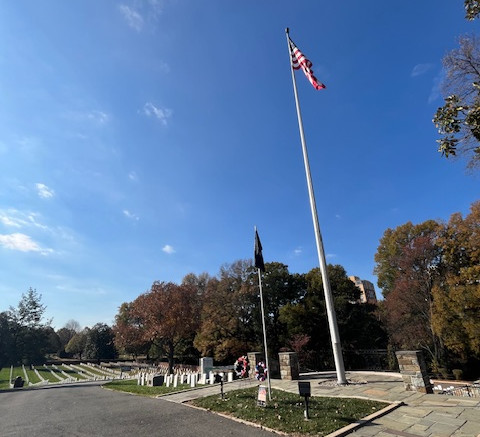
As you walk through Alexandria National Cemetery, you’ll see a granite boulder near the flagpole. It honors four civilian Army employees who drowned in the Potomac River in April 1865 while taking part in the search for John Wilkes Booth after President Abraham Lincoln’s assassination. The four men are buried near the memorial, which was erected in 1922.
There are also veterans of later wars buried here. One of them is Lillian Edwards, who served in the U.S. Navy during World War I and became a chief yeoman. After her military service, she worked for the federal government and retired from the Veterans Administration in 1957. Her grave is in Section D.
Alexandria National Cemetery is at 1450 Wilkes Street and is open daily from sunrise to sunset. If you’re in Alexandria, I hope you’ll take a walk through the cemetery and stop to read a few of the names. If you can’t make it here, I hope you’ll find a place in your own city or town where you can do the same.
Sources


Comments