
Potomac Yard: The Massive Railroad Operation That Once Dominated Alexandria
Visit Potomac Yard today and you'll find apartments, townhomes, restaurants, a Metro station, and Virginia Tech's new Innovation Campus — one of the fastest-changing corners of Alexandria. But less than a century ago, this same ground looked nothing like that.

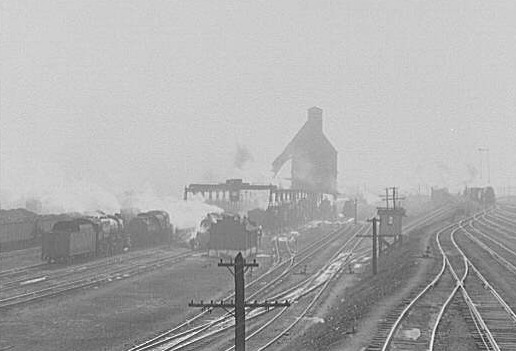
Instead of storefronts and sidewalks, picture mile after mile of railroad track packed with freight cars. Picture locomotives running around the clock, workers sorting thousands of cars each day, and trains rolling north toward Washington or south toward Richmond at all hours. This was Potomac Yard. It was once one of the largest and busiest railroad classification yards on the entire East Coast.
Potomac Yard: A Gateway Between North and South
Potomac Yard was built to solve a problem the railroads couldn't ignore. By the early 1900s, enormous volumes of freight were moving up and down the East Coast, but different companies controlled different stretches of track. A freight car heading north out of the South might arrive in Alexandria on one railroad and need to continue toward Baltimore, Philadelphia, or New York on another entirely. Somebody had to hand those cars off — efficiently, and at scale.
Alexandria turned out to be the perfect place to do it. The site sat just south of the Long Bridge over the Potomac and north of St. Asaph Junction, squarely on the corridor linking northern and southern rail networks. A group of competing railroad companies cooperated to build a massive interchange facility there, operated by the Richmond, Fredericksburg and Potomac Railroad — the RF&P. Potomac Yard opened on August 1, 1906 and grew into the largest railroad classification center on the East Coast.
What a Classification Yard Actually Did
A single freight train arriving in Alexandria might haul 80 to 100 cars. Those cars weren't all going to the same place. Some were bound for Baltimore, others for Philadelphia or New York, still others needed to switch onto a different railroad entirely. So the incoming train had to be taken apart, car by car, and rebuilt into new trains organized by destination. Think of it as an enormous sorting facility such as a post office except instead of sorting packages, workers were sorting entire railroad cars.
They did it using gravity. Potomac Yard relied on artificial hills called "humps." A locomotive pushed a string of cars up the hump. At the crest, workers uncoupled them one at a time and let gravity roll each car down the far side, where switches guided it onto the classification track matching its destination. Cars headed the same direction were gradually assembled into a brand-new train. At its peak, the yard held 89 classification tracks — roughly 50 for northbound traffic and 39 for southbound along with additional tracks just for receiving incoming trains.

That was only part of an almost unimaginably large complex that was administratively intensive. When Potomac Yard opened in 1906, it contained about 52 miles of track. By its peak, it had grown to roughly 136 miles of track, packed into a corridor only about two and a half to three miles long. Drive through Potomac Yard today, past the apartments, parks, shops, and the Virginia Tech campus, and try to mentally erase nearly everything you see. Replace it with 136 miles of railroad track.
More Than 10,000 Freight Cars a Day
America's entry into World War II placed enormous strain on the nation's rail network, and Potomac Yard became a vital link in it. At its 1945 peak, the yard handled roughly 10,000 freight cars a day. For two straight years, the pace barely let up: a train dispatched north, another south, roughly once an hour, every hour, around the clock — each one 80 to 100 cars long.
Try to imagine standing in this part of Alexandria in 1945. Another massive freight train rumbles north. Then another heads south. Then another through the afternoon, through the night, into the next morning, for two years running. It was a 24/7 operation.
The People Who Kept It Running
None of that happened on its own. During the war years, Potomac Yard's workforce swelled to roughly 1,500 to 1,600 people, working around the clock in overlapping shifts. Historical accounts describe five crews by day and one at night, six total. Crews worked 12-hour shifts with a single hour set aside for meals. There were engineers running locomotives, workers throwing switches, inspectors checking cars, mechanics keeping equipment running, and "car riders" controlling cars as they rolled down the humps.
There was also an enormous amount of paperwork behind the scenes. Every single car had to be tracked: where it came from, who owned it, where it was headed, which railroad was set to receive it. Every transaction was documented, checked, and often checked again. Potomac Yard wasn't just moving freight. It was moving a staggering, complex amount of information and data.
The yard also supported a whole economy of its own. Cars needed inspection and repair; locomotives needed fuel and servicing. Before mechanical refrigeration became widespread, refrigerated cars carrying fruit, vegetables, and other perishables needed to be repacked with ice along the way. Alexandria's nearby Mutual Ice Company supplied it. Potomac Yard built an entire business ecosystem to support the movement of freight trains.

Building Neighborhoods, One Paycheck at a Time
The yard's influence reached far beyond its own tracks. Thousands of workers needed somewhere to live, and whole neighborhoods grew up around the railroad. Del Ray and St. Elmo were incorporated together as the Town of Potomac in 1908 before Alexandria annexed them in 1930. These neighborhoods became closely tied to the railroad workforce, and communities including Lynhaven and Hume Springs developed strong ties to Potomac Yard workers as well.
For many Alexandria families, the yard wasn't just an industrial site they drove past. It was their livelihood. By 1965, Potomac Yard reportedly carried an annual payroll of around $4 million and generated roughly $250,000 in taxes for the City of Alexandria. For years, it was Alexandria's single biggest source of tax revenue.
Why the Yard Declined
Transportation was changing underneath Potomac Yard's feet. Diesel locomotives needed less labor to operate than steam had. Computerization and new tracking technology made yard operations more efficient, which meant fewer workers. Freight itself was shifting, too: by the 1960s, "piggybacking" was a common practice. This involved placing truck trailers directly onto rail flatcars, and blended highway and rail transport in ways that reduced the need for massive classification yards. Meanwhile, the interstate highway system kept expanding, pulling freight — and jobs — onto the roads.
The numbers tell the story. From roughly 1,600 workers during World War II, the workforce had fallen to about 490 by 1978. The yard was still active that year, with six railroads still routing traffic through it including Conrail, RF&P, Southern Railway, Baltimore & Ohio, Chesapeake & Ohio, and Delaware & Hudson. But the transportation system that had once made a facility this size indispensable had moved on. By the late 1980s, Potomac Yard's rail operations wound down for good.

From Railroad Yard to Neighborhood
That left Alexandria with a genuinely unusual question: what do you do with hundreds of acres of former railroad land in one of the most valuable corridors in Northern Virginia? The answer took decades to work out. Developers, including Pulte, began building townhomes and condominiums on the site in the early 2000s, and retail, parks, and office space gradually followed. The first major shopping center opened in 1997 in the northern part of Potomac Yard.
Then, in a twist of historical symmetry, rail came back to Potomac Yard albeit in a completely different form. On May 19, 2023, the Potomac Yard-VT Metro station opened. Instead of sorting freight cars between competing railroads, the trains now carry commuters into Washington and across Northern Virginia on the Washington Metrorail system.
The transformation kept going. Virginia Tech's Innovation Campus opened its first academic building on the site in early 2025, bringing students, researchers, and advanced technology and engineering programs to land once dominated by one of America's great railroad operations. One hundred twenty years ago, Potomac Yard represented cutting-edge transportation technology. Today, the same land is being reshaped by education and technology all over again. What hasn't changed is the reason this ground has always mattered: location, sitting right on the corridor between Washington and points south.

A Transportation Corridor, Reinvented
Potomac Yard's story is really a microcosm of Alexandria's story. It is a place that keeps reinventing itself while staying true to what made it valuable in the first place. In 1906, railroad companies recognized that this narrow strip of land between Alexandria and Washington sat in an extraordinary position between North and South, and they built a complex that eventually held 136 miles of track. During World War II, some 1,600 people worked there, and at its 1945 peak the yard handled more than 10,000 freight cars a day on trains that could 100 cars long.
Almost none of that infrastructure survives today. But the next time you're driving through Potomac Yard or passing it on the Metro, try to imagine a vast landscape of locomotives, freight cars, humps and classification tracks, ice houses, and round-the-clock industry that quite literally helped build the neighborhoods around it.
The railroad yard disappeared. The transportation corridor never did.
Want to see the traces of it for yourself? Alexandria History Tours has provided tours via bus through Potomac Yard and other parts of Alexandria. If you are interested, please reach out via e-mail, tim@alexandriahistorytours.com. You can also check out our daily walkoing tours in Old Town Alexandria where we discuss many of Alexandria's incredible hidden gems like Potomac Yard. Book your tour and come discover the stories beneath your feet.
Image Sources:
Image: U.S. President's Railroad Commission Photographs #5003 P. Kheel Center for Labor-Management Documentation and Archives, Cornell University Library
Horydczak, Theodor, Approximately, photographer. Railroad yards. Potomac Yards in Alexandria, Virginia I. Alexandria United States Virginia, None. ca. 1920-ca. 1950. Photograph. https://www.loc.gov/item/2019677951/.
Virginia Tech image link.
Published Works Used:
Bromberg, Francine W. The History of Potomac Yard: A Transportation Corridor through Time. Alexandria Archaeology, City of Alexandria. Read the Potomac Yard history PDF
City of Alexandria, Alexandria Archaeology. History and Archaeology at Potomac Yard. History and Archaeology at Potomac Yard
History of Potomac Yard presentation: https://www.youtube.com/watch?v=zyljaYyvfM8
City of Alexandria. History of Del Ray and the Town of Potomac. History of Del Ray and the Town of Potomac
Washington Metropolitan Area Transit Authority. Now Open, Metro Celebrates First Day of Service at Potomac Yard-VT Station. May 19, 2023. WMATA: Potomac Yard-VT Station Opening
Virginia Tech. Academic Building One. Virginia Tech Academic Building One


Comments